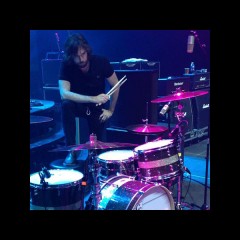
Sonny & the Sunsets had a fantastic vibe at Pitchfork. In fact, its hard to think of an adjective besides, “sunny.” Clever arrangements, and each person in the band had moments to shine during the set. Kelley holds the drum chair for this group, as well as his own solo project, which he describes as “4/4 blues-based rock.” Kelley enlightened me with his non-nonsense approach, celebrating classic influences but with the benefit of a post-pop lens.
Posted 6 days, 18 hours ago at 12:47 pm. Add a comment
Anthony LaMarca played a dynamic set with St. Vincent at this year’s Pitchfork, running the gamut from laid-back Levon Helm-style pocket to rigid Kraftwerkian tick-tock, and then finally spreading his free-jazz wings and cutting loose with a chaotic accompaniment to a feedback coda. His performance was the practicing of what he preached in our interview: put the song first, keep it simple, but also embrace the new possibilities opened up by technology.
You can see why he’s been called on, not just by Annie Clark (St. Vincent), but also dream-pop patriarch Dean Wareham (Galaxie 500) to be part of their supporting casts. You’ll be able to catch him again in a few months when Dean & Britta play at Lincoln Hall in December.
The transcript is in the Description area of the video. -Paul Goodenough
Posted 6 days, 21 hours ago at 9:32 am. Add a comment
Justin Peroff has crafted some of the catchiest drum parts of the new millenium with Broken Social Scene. Survey the past few years of indie music, and then go back and listen to You Forgot It In People. See what I mean? Some very influential grooves on that record. The excellence continues on their latest, Forgiveness Rock Record. He cuts through the wall-of-sound guitars and swirling vocals with crunchy hi-hats (“Forced to Love”), punching-bag bass drums (“Art House Director”), well-thought-out beats (“Romance to the Grave”) and good old-fashioned epic drum fills (“Water in Hell”).
Justin opens up about working with one of his biggest influences, John McEntire of Tortoise, and his anchoring role in the Noah’s-Ark-like ensemble.
Transcipt is below the video if the audio is too dodgy for you. -Paul Goodenough
TBDITW: Thanks for joining us. A big thank you to Jusitn Peroff of Broken Social Scene. Thanks for coming on, Justin. How long have you been playing with Broken Social Scene?
JP: Since the beginning, which was, I would say, 10 years ago.
TBDITW: And what is your main instrument?
JP: My main instrument is the drums.
TBDITW: What drummers who are playing now have really impressed you?
JP: I had the honor of working with John McEntire on this last record. And for us to even be in correspondence with him is a really big thing. And now I consider him a friend. That was massive for me since he is actually one of my favorite drummers. I’ve been heavily influenced by him. And he’s going to be playing with us tonight. That was like dream come true.
TBDITW: I noticed a lot of tracks on the album feature him on drums as well. How’d that work out? Was it at the same time or layered?
JP: Some of the parts are doubled – he doubled me on World Sick. He doubled me on some parts to beef it up a little bit. He recorded his drums in a different room, in a different way, with a different set up. On one song, “Ungrateful Little Father,” he’s playing the main drum part on that. He’s playing the main part on the Andrew Whiteman song, “Art House Director.” So on some songs it’s doubled, some are not, some have separate parts that complement each other.
TBDITW: Was there any tricks, any techniques of his that you really picked up on?
JP: If I did, it wasn’t anything specific, it was more subliminal. ‘Cause if I did, its not like I knew the guy when I was growing up listening to his records to be like “How’d you do that?” Sometimes subliminally, sometimes actually dissecting the part, you translate it in your own way and you approach it in your own way. The sound is a destination as opposed to a “how.”
TBDITW: What are some of the challenges to playing in a group with 9, 10, 11 people?
JP: Anchoring the stage sound. Telling people to turn down a lot. Getting In-Ears for the first time ever on this tour has helped me a lot. I can just dial in what I want, and everything else is pretty much nonexistent. So it’s almost like I’m pretending like the stage sound is taken care of, but it’s just taken care of in my head.
It is a challenge. But it’s a good challenge.
TBDITW: How do envision your role in the band recording and when you play live?
JP: How do you mean?
TBDITW: Well, you touched on “anchoring” the band. Does that carry over into “you’re the driver” or “you draw up the setlist?”
JP: Actually me and Kevin do the setlist together. Because we’re sticklers for things even like record sequence and the general flow of songs. And sometimes I don’t like certain songs to be together because it would be exhausting, or because of the flow, or certain beats are similar and we want them separate.
I guess I’m one of the (inaudible) members, and it weird to say that, but I’m just really fucking stubborn when it comes to my band. I’m really specific about how I think things should be, so I really don’t censor myself. Sometimes you have to be the squeaky wheel when there’s a lot of people. So I’m the annoying guy.
TBDITW: Well, that might be a universal drummer characteristic. What are some of your drumming strengths?
JP: I have no idea. You should let me know, after the show. I don’t know if I have any at all.
TBDITW: One thing I really like, a signature Justin Peroff move to me, which I don’t remember hearing until one of your first records was “Doo Doo Cha Ts Ts Doo Cha,” “…and 3…and 3…” Where’d that come from?
JP: I think I first did that in “Stars and Suns” during the breakdown. I think it was a combination of that rhythm, that pattern, but it was really made clear due to David Newfeld’s production. He’s a big fan of drums, he’s a big fan of my drumming he makes me sound way better than I actually am. With a lot of the compressors he uses, and the way the mics are situated, he either turns up mics that are way over there or over here there’s other sort of patterns that reveal themselves. So originally it was due to his production. And then after that, going back and listening to my own record, I was like, “(inaudible).”
I actually have friends who will make fun of me. They’ll just start mouthing drum patterns of mine, and that is one of them.
TBDITW: What’s your proudest contribution to the new album?
JP: That rhythm right there. No, I don’t know. The introduction of the (Roland) SPD-S drum machine was really fun. I started using it on the road before this tour. And playing around with John McEntire’s drum machine collection, having the liberty to do that, that was a fun contribution. And ultimately, it was fun to communicate the live drumming with a lot of those other drum patterns. That was a notable rhythm texture that happened from working with John.
TBDITW: You’re credited with vocals on the album? What was that?
JP: It’s called “Highway Slipper Jam.” There’s two studios. There’s the actual studio, and then there’s another room. They were doing some playback and I was in the hall just walking to the kitchen and I started singing that line as a joke, and the guys were like, “You need to record that right now.”
TBDITW: It’s quite humorous.
JP: It’s humorous for sure.
TBDITW: I like the element of humor.
JP: It’s a happy record.
TBDITW: It is! Forgiveness, happiness…do you have any feelings on what does the record mean to you? Kevin Drew said in an interview that it wasn’t like “religious” forgiveness necessarily. What does it mean to you?
JP: I think that any record that, I think this goes for a lot of artists, records are kind of like love letters for many reasons one of the emotions happened be leading throughout this whole thing was forgiveness, for a number of reasons. But I’m not really qualified to answer that since I’m not a lyricist.
“Why? is the process of adapting to the business of living.” That’s from Why?’s website bio…it’s loaded with some heavy words, but nothing less would represent the band’s intense brand of inquisitive hip-hop. Josiah Wolf does an amazing job playing drums and vibraphone at the same time. The beats meld memorable melodies with tense rhythms, which complement Yoni Wolf’s (his brother) surreal lyrics. Here’s a picture of him playing kit, vibes, and singing!
But the multi-tasking isn’t a gimmick. It happened quite organically, in fact, out of necessity. And Josiah takes it to next-level greatness with his execution. Even when playing freely improvised drum fills with maracas, he tops it off with a perfectly-timed maracas-throw to Yoni to signal the return to the chorus. I loved the songs, I loved the show — one of the highlights of Pitchfork 2010. I was lucky enough to talk to him about his unique set-up, and the importance of confidence. Some of the audio is a bit patchy, so I included a transcript in the video description, and refer to that if you have any questions on quotes. -Paul Goodenough
One of my drum students alerted me to Bear In Heaven‘s intriguing sound and layered grooves after stumbling upon them at a bar. Less than a year later, they’re playing a great set at Pitchfork Music Festival. Particularly impressive is the way Joe Stickney keeps the band lock-and-step with solid time, intricate coordination, and dropping in with drum fills at just the right time.
Listening to the records, I assumed that those layered drum parts were programmed – I was wrong. Joe is a great drummer, coordinating different parts on each limb. Passionately pushing the music forward while complementing synth-based music, you might say he’s sort of like the beating heart of the Tin Man. -Paul Goodenough
and here’s recent performance of theirs where you can witness Joe in action. Watch it, then make sure you catch Bear In Heaven’s next show near you:
Let me warn you about Delta Spirit. They have more soul than you can handle.
After interviewing their drummer this band blew me away. But not like you get blown away by your usual ___ band.
It’s not exactly happy go lucky music. But it is real. If you love or can relate to a tortured soul this could be the band to save yours. Think New Orleans and you’ll have some concept of the sound.
But their live delivery is more like a religious sermon delivered by a jaded pastor who doesnt believe anymore and wonders if his flock knows he’s fakin it.
The fact that the majority of the guys in the band have played drums can be seen in this great track from Ode to Sunshine.
I got the instant groove in from drummer Brandon Young before the show. He didn’t warn me about what I was in for. Buy Ode to Sunshine if you want to feel something.
Posted 6 months, 4 weeks ago at 8:40 pm. Add a comment
One of the great things about having this site and interviewing bands is that I always get to discover new and cool bands.
Most of us have a network of friends or trusted sources who turn us on to new music.
When you interview drummers you dig in bands you dig you get the bonus of getting turned on to the bands these guys dig enough to take on the road with them. So there’s a good chance you (I) will end up liking the opening band.
In the case of The Golden Dogs from Toronto, I loved this band. They were absolutely amazing live. Sloan drummer Andrew Scott told me I had to interview their drummer because he was incredible. Understatement. Taylor Knox is an amazing drummer, and he calls himself a songwriter.
I swear, those songwriters make the best drummers.
The record Big Eye Little Eye was one of my most listened to records of the year. I hate to compare bands to other bands (mostly because I hate being compared to other bands) but if the Strokes are considered a “big” band, The Golden Dogs should be as big as U2.
Here’s their video for the catchiest song you’re going to hear today.
I edited the talk we had about where our families have cottages in Canada right down the road from each other, but we talk about the band, so here you go.
Posted 6 months, 4 weeks ago at 8:20 pm. Add a comment
My obsession with Nada Surf was sparked by Weezer. Ric Ocasek of the Cars who produced the first Weezer record which sounded amazing. (The fact that he messed with Guided By Voices we shall leave to another post)
Around that time he also produced a record by a New York band called Nada Surf. They had a moderate hit with the song “Popular” and then were lost in major label confusion land.
They resurfaced a few years ago on the hipster radar and a friend of mine turned me onto the “new” Nada Surf and I was blown away. Absolutely great songs.
The truth is there was nothing new about the band except they just kept on doing what they do and persisted and the beauty is that they really have come out on top.
They really seem to have found a smooth stride in phase 2 of a career where most bands don’t get a shot at a phase 2.
This is a video for the song Weightless off their latest album Lucky. The band held a contest where fans could make the official video for the song. This video was a runner up, but I thought it encompassed the aesthetic of a great song.
Come on, skydiving? That pretty much rules.
Ira is trully a music fan and drum junkie. He loves talking drums and drumming and he used the term “Ringo School” which I’ve used, but he made it sound official. So I’m using it now all the time.
Here’s the interview
Posted 6 months, 4 weeks ago at 7:49 pm. Add a comment
I grew up in Windsor, Ontario, right across the boarder from Detroit.
When I was a kid, I didn’t even know that America was a seperate country. My best friend John’s parents worked in Detroit and I remember one day when they were talking about crossing the border each day to go to work, and how the customs officials were getting tougher. I thought “What the hell? Customs? Is America a different country??? I thought The Beatles already conquered America?” I was totally confused.
So, in a vain attempt to conquer the world myself, I moved to “The States” to be a “Rock-Starr, like Ringo Starr, get it?)
This concept of conquering America is not new for aspiring musicians. But as I age, it seems more and more misguided a goal.
How about making great music? How about having an enduring career? How about doing something you believe in?
I think I was hoodwinked by the alure of KISS Alive! Damn you Gene Simmons.
But not Sloan.
Sure, they had theire big American hit song with Underwhelmed.
But then they got called “The Nirvana of The North”. An underwhelming title in itself.
I won’t pretend to know all about what they went through or what decisions they made. Or if they ever fought about “moving to The States to become Rock-Starrs” But one thing is obvious….
They decided to continue on and make great music they were proud of.
If you’re a “typical american” (that’s what they call us up in Canada) Then you may not even know who Sloan are. Urgh. Here’s a video for the un-informed.
Plus, this song has a line about living in Canada
So it is with this confused background that I sat down with Sloan drummer Andrew Scott.
Sloan are one of my favorite bands and this is one of the best drummers you may have never heard of.
My love for Power Pop songcraft is obvious and, first and foremost Sloan write great songs. Great harmonies and every guy in the band writes.
The reason I think this band is so important is a) they write great songs b) they’re super tight and super pro live. But there’s a secret weapon in Andrew Scott and here’s why;
He makes the case for the “Keith Moon Factor”
If you’re a drummer and you love Keith Moon, you know that he is the ultimate “outside the box” drummer. He doesn’t play a hi-hat. He pretty much solos all the time. Listen to I can See For Miles if you don’t know what I’m talking about.
And, if you’ve ever played in a band where the guitar player says the famous “you’re overplaying” . Then you have an ally in Andrew Scott.
He’s the only drummer I know in the straigt ahead rock genre that secretly sneaks in Keith Moon style fills at every turn.